* The estimated amount of time this product will be on the market is based on a number of factors, including faculty input to instructional design and the prior revision cycle and updates to academic research-which typically results in a revision cycle ranging from every two to four years for this product. Pricing subject to change at any time.

Instructor Quick Actions

Get eBook Access Get access as soon as you validate!
Request a Print Sample Get a copy as soon as validated.
Contact a Rep Find a local rep best suited for you.
Find Rep

Product Information

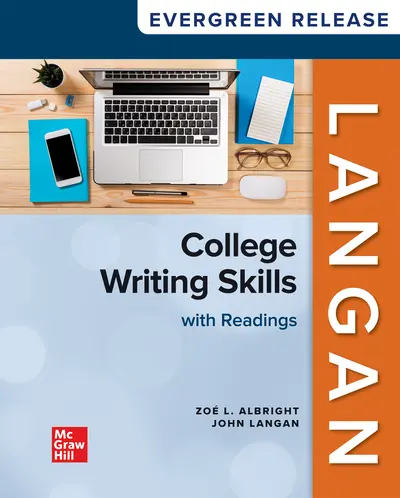
College Writing Skills with Readings emphasizes writing skills as well as process. The text identifies a set of four fundamental skills that are critical to effective writing:

Unity: Discover a clearly stated point, or topic sentence, and make sure that all other information in the paragraph or essay supports that point.

Support: Buttress the points with specific evidence, and plenty of it.

Coherence: Organize and connect supporting evidence so that paragraphs and essays transition smoothly from one piece of supporting information to the next.

Sentence Skills: Revise and edit so that sentences are error-free for clearer and more effective communication. These four bases are essential to all effective writing, whether it be a narrative paragraph for a personal journal, a cover letter for a job application, or an essay for an academic assignment.

McGraw Hill eBooks and digital platforms use an Evergreen delivery model with a release-centered process that makes it easy to keep courses fresh, engaging, and relevant.

Release Notes provide detailed information about new and updated content delivered with each release.

Your account requires validation. Please contact your sales representative.

  • Part 1 - Essay Writing
  • 1. An Introduction to Writing
  • 2. The Writing Process
  • 3. The First and Second Steps in Essay Writing
  • 4. The Third Step in Essay Writing
  • 5. The Fourth Step in Essay Writing
  • 6. Four Bases for Revising Essays
  • 7. Developing an Essay
  • Part 2 - Patterns of Essay Development
  • 8. Description
  • 9. Narration
  • 10. Exemplification
  • 11. Process
  • 12. Cause and/or Effect
  • 13. Comparison and/or Contrast
  • 14. Definition
  • 15. Division-Classification
  • 16. Argument
  • Part 3 - Researching, Writing and Documenting
  • 17. Information Literacy
  • 18. Summarizing and Paraphrasing
  • 19. Writing a Source-Based Essay
  • 20. Writing a Research Essay
  • Part 4 - Handbook of Sentence Skills
  • Section I - Grammar
  • 21. Subject and Verbs
  • 22. Fragments
  • 23. Run-Ons
  • 24. Regular and Irregular Verbs
  • 25. Subject-Verb Agreement
  • 26. More about Verbs
  • 27. Pronoun Agreement and Reference
  • 28. Pronoun Types
  • 29. Adjectives and Adverbs
  • 30. Misplaced Modifiers
  • 31. Dangling Modifiers
  • Section II – Mechanics and Punctuation
  • 32. Capital Letters
  • 33. Numbers and Abbreviations
  • 34. Apostrophe
  • 35. Quotation Marks
  • 36. Comma
  • Section III – Word Use
  • 37. Commonly Confused Words
  • 38. Effective Word Choice
  • Section IV – Tests
  • 39. Editing Tests
  • Part 5 – Readings for Writers
  • Introduction to the Readings
  • Building Self-Awareness
  • Education and Learning
  • Challenging Societal Values
  • Index
  • Instructor's Guide

About the Author

John Langan

John Langan has taught reading and writing at Atlantic Cape Community College for more than 25 years. The author of a popular series of college textbooks on both writing and reading, John enjoys the challenge of developing instructive materials that are clear and lively. Before teaching, he earned advanced degrees in writing at Rutgers University and in reading at Rowan University. He also spent a year writing fiction that “is now at the back of a drawer waiting to be discovered and acclaimed posthumously.” While in school, he supported himself by working as a truck driver, a machinist, a battery assembler, a hospital attendant, and an apple packer. In addition to his wife and Philly sports teams, his passions include reading and conveying to nonreaders the pleasure and power of books. Through Townsend Press, his educational publishing company, he has developed the nonprofit “Townsend Library”—a collection of more than 100 new and classic stories that appeal to readers of any age.

Zoe L. Albright

Zoé L. Albright has been involved in diverse aspects of education for 22 years. For the last 18 years, she has been a faculty member at Metropolitan Community College–Longview, teaching developmental writing, composition, and literature. She has created and implemented traditional and online curricula for high school and college English and composition courses and for a variety of literature courses. She continues to research new educational theory and practices. Zoé has most recently served as co-author of English Skills with Readings, ninth edition, and contributing author to other Langan texts. She received her M.A. from Goldsmiths, University of London; B.S. and B.A. from the University of Idaho; and A.A. from Cottey College. She is currently pursuing a Ph.D. in Curriculum and Instruction at the University of Kansas. Zoé currently resides outside Kansas City, Missouri, with her husband and teenage son.

Accessibility

Creating accessible products is a priority for McGraw Hill. We make accessibility and adhering to WCAG AA guidelines a part of our day-to-day development efforts and product roadmaps.

For more information, visit our accessibility page, or contact us at accessibility@mheducation.com

affordability icon

Affordability

Reduce course material costs for your students while still providing full access to everything they need to be successful. It isn't too good to be true - it's Inclusive Access.

Need support?   We're here to help - Get real-world support and resources every step of the way.

Top